Can Mold Spread Through Drywall?
Quick Answer
Mold doesn’t soak through solid drywall, but it spreads across it, into it and around it. It feeds on the paper facing, often grows unseen on the back side, and its spores ride air currents through gaps, outlets and the wall cavity. Drywall with more than light surface mold usually has to be cut out.
How Mold Grows on Drywall
Drywall is a gypsum core sandwiched between two sheets of paper. The paper is the main food source for mold. Gypsum board kept dry doesn’t grow mold: the Gypsum Association states that gypsum board “does not generate or support the growth of mold when it is properly transported, stored, handled, installed, and maintained,” and adds in capitals that it “MUST BE KEPT DRY.”
The problem starts when the paper stays damp. It doesn’t have to be soaking wet. Building scientist Joseph Lstiburek explains that “at 80 percent relative humidity you get liquid phase water in the pores of the paper faced gypsum,” which is enough for mold. Leaks, condensation inside the wall and high humidity can all get the paper there.
Once mold is established, it grows across the paper and into it. EPA notes that mold “can grow on or fill in the empty spaces and crevices of porous materials, so the mold may be difficult or impossible to remove completely.” That’s the key difference between drywall and a hard surface like tile or glass.
Why the Back Side Is the Bigger Problem
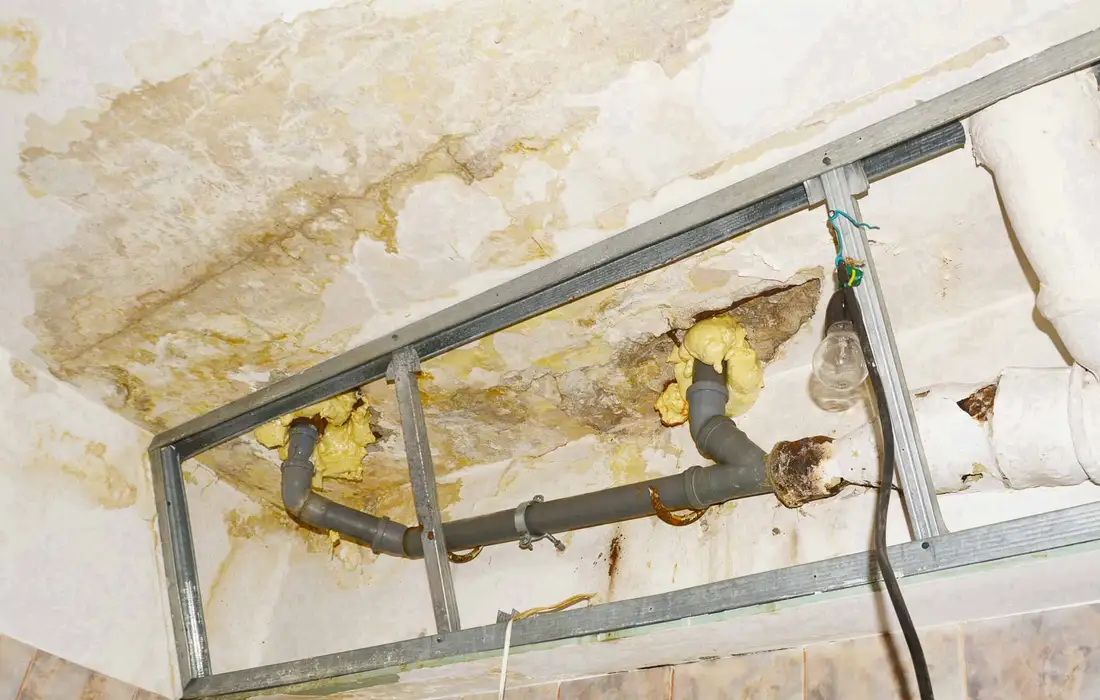
Most of the water that reaches drywall comes from inside the wall: a leaking pipe, a condensing cold water line, a roof or window leak running down the framing. So mold usually starts on the back of the board, in the dark, where nobody sees it.
EPA lists “the back side of dry wall” first among places mold hides, along with “areas inside walls around pipes (with leaking or condensing pipes)” and “the surface of walls behind furniture (where condensation forms).”
By the time a stain or spots show on the painted side, the hidden side may have far more growth. Vinyl wallpaper or wood paneling can make it worse: EPA notes they may act as vapor barriers, trapping moisture underneath where mold can grow.
How Mold Spores Actually Travel
The idea that mold “goes through” a wall to the next room is half right. The growth stays on the material, but spores move with air.
A full-scale laboratory study of a timber-framed wall found that spore movement through the structure was “highly dependent on pressure difference over the structure but not on holes in surface boards.” In other words, spores move where air moves: through joints, gaps and openings, pushed by differences in air pressure, not through solid board.
| How spores move | What carries them | What to do |
|---|---|---|
| Gaps at outlets, switches and baseboards | Air pressure differences between the wall cavity and the room | Don’t run fans that blow toward a moldy wall; seal off during cleanup |
| Along the wall cavity | Air moving inside the wall, up to the attic or across to other rooms | Open the wall to find the full extent before cleaning |
| Heating and cooling system | Returns pulling air from near the mold and spreading it | EPA: don’t run the HVAC system if you suspect it’s contaminated |
| Disturbing the mold | Cutting, breaking or peeling moldy material | Wear an N-95 respirator, gloves and goggles; contain larger areas |
EPA warns: “Do not run the HVAC system if you know or suspect that it is contaminated with mold,” because it could spread mold throughout the building. It also cautions that removing wallpaper “can lead to a massive release of spores if there is mold growing on the underside of the paper.” The same applies to breaking up moldy drywall, which is why cleanup has to be done carefully.
Warning Signs of Mold in or Behind Drywall
- Stains or discoloration, especially spreading rings or streaks below a pipe, window or ceiling fixture
- Bubbling, peeling or flaking paint
- Soft, crumbling or swollen drywall, or seams that have opened
- A musty smell with no visible source. EPA says you may suspect hidden mold “if a building smells moldy, but you cannot see the source.” See why your house smells musty.
- Black, green or white spotting along the bottom of a wall or around a ceiling stain
- A history of water damage in that area, even if it looked dry afterwards
Checking Drywall With a Moisture Meter
A pin or pinless moisture meter can confirm whether a stain is still wet, and how far the damp area spreads. Moisture meter maker Delmhorst says drywall is considered moisture-compromised once its moisture content goes above 1%.
Meter readings are relative, so the most reliable method is to compare:
- Take a reference reading on the same wall in an area you know is dry, away from the stain.
- Read across the suspect area in a grid, every 6 to 12 inches, working outward until readings return to the reference level.
- Mark the edge of the high readings with painter’s tape. That’s the minimum area affected.
- Recheck after drying. Readings should come back down to the reference level before the wall is closed up or painted.
Delmhorst notes that “even a slight increase over the sample reading can be indicative of moisture in drywall.” For more on what the numbers mean on different materials, see our guide to normal moisture meter readings.
Clean It or Cut It Out?
Mold can be wiped off hard surfaces. Drywall is porous, so the answer depends on how much there is and how wet the board has been. EPA’s remediation guidelines (Tables 1 and 2) give the framework:
| Situation | What EPA guidance points to |
|---|---|
| Drywall got wet but has no mold, no swelling and intact seams | May be dried in place, within 24 to 48 hours; ventilate the wall cavity if possible |
| Drywall is swollen, crumbling or seams have opened | Remove, discard and replace |
| Mold on drywall, less than about 10 sq ft | Dry it, remove contaminated material, then HEPA vacuum; N-95 respirator, gloves and goggles, no containment needed |
| Mold on drywall, 10 to 100 sq ft | Remove and bag moldy materials, with plastic containment around the area |
| Mold over 100 sq ft, or after major water damage | Professional remediation with full containment |
| Water was sewage or floodwater | Call a professional experienced with contaminated water |
EPA’s general rule for homes: if the moldy area is less than about 10 square feet, “in most cases, you can handle the job yourself.” If there’s been a lot of water damage or mold covers more than 10 square feet, follow its professional remediation guidance.
A few things that don’t work on moldy drywall:
- Painting over it. EPA: “Do not paint or caulk moldy surfaces.” Paint over mold is likely to peel.
- Spraying bleach or vinegar and leaving it. EPA does not recommend bleach as a routine practice in mold cleanup, and it notes that “it is not enough to simply kill the mold, it must also be removed,” because dead mold can still cause allergic reactions.
- Cutting out only the visible spot. Use the moisture readings and check the back of the board. Drywall maker PABCO notes that after flooding, “the drywall will need to be removed to inspect the insulation and framing. If this step is skipped, mold can grow and possibly go unnoticed.”
Health: What CDC Says
CDC’s guidance is measured. “Exposure to damp and moldy environments may cause a variety of health effects, or none at all.” People most at risk are those with asthma or mold allergies, who “may have severe reactions,” and people with weakened immune systems or chronic lung disease, who “may get infections in their lungs from mold.”
On so-called black mold, CDC says no test exists that proves an association between Stachybotrys chartarum and particular health symptoms, and that “all molds should be treated the same with respect to potential health risks and removal.” CDC does not recommend mold testing: whatever the type, remove it.
If you have symptoms that don’t go away, see your doctor. EPA also advises: “If you have health concerns, consult a health professional before starting cleanup.”
Keeping Mold Out of New Drywall
Replacing the board without fixing the moisture just restarts the clock. Before new drywall goes up:
- Fix the source: the leak, the condensing pipe, the gutter or the grading that’s sending water into the wall.
- Dry the framing and insulation and confirm with moisture readings.
- Dry quickly next time. EPA: if wet materials are dried within 24 to 48 hours, in most cases mold will not grow.
- Keep indoor humidity below 60%, ideally 30% to 50%.
- Consider mold-resistant board in bathrooms, basements and laundry rooms. It helps but isn’t mold-proof; see is mold-resistant drywall worth it.
Think There’s Mold Behind Your Walls?
Stains, a musty smell or a past leak are worth checking before mold spreads further inside the wall. We’ll connect you with local mold remediation and water damage professionals who can find the moisture, open up only what’s needed and remove the mold safely. Call us any time, or request a free estimate.
Frequently asked questions
Can mold spread from one room to another through a wall?
Not by passing through solid drywall. Spores travel on air, so they move through gaps: outlets, switch boxes, baseboard gaps, plumbing holes and the open space inside the wall. Air pressure differences between rooms, and a running HVAC system, are what carry them.
Can I paint over mold on drywall?
No. EPA advises against painting or caulking moldy surfaces. Paint over mold is likely to peel, and the mold keeps growing underneath. Clean up the mold, fix the moisture source and let the surface dry before painting.
Will bleach kill mold in drywall?
Bleach won't fix moldy drywall. EPA does not recommend bleach as a routine part of mold cleanup, and killing mold isn't enough because dead mold can still cause allergic reactions. Mold also grows into porous drywall, so badly affected sections usually need to be removed.
How fast does mold grow on wet drywall?
EPA says that if wet materials are dried within 24 to 48 hours of a leak or spill, in most cases mold will not grow. After that, the risk rises quickly, especially on the paper facing of drywall.
Can wet drywall be saved?
Sometimes. EPA's guidance says wet drywall may be dried in place if there is no obvious swelling and the seams are intact. If it's swollen, crumbling or already moldy, it should be removed and replaced.
Do I need a mold test before removing moldy drywall?
Usually not. CDC does not recommend mold testing, because whatever type of mold is present, it should be removed. Testing can help find hidden moisture or mold, but it doesn't change the basic fix.
Sources
- EPA: A Brief Guide to Mold, Moisture and Your Home
- EPA: Mold Remediation in Schools and Commercial Buildings, Chapter 3
- EPA: Mold Remediation Guide, Chapter 4 (Table 1, water damage cleanup)
- EPA: Mold Remediation Guide, Chapter 5 (Table 2, remediation guidelines)
- CDC: About Mold and Your Health
- CDC: Mold facts and statistics
- Building Science Corporation: BSI-099, It's All Relative
- Gypsum Association: Guidelines for Prevention of Mold Growth on Gypsum Board (GA-238)
- PABCO Gypsum: Mold Growth in the Desert
- AIVC: Fungal spore transport through a building structure (Airaksinen et al., Indoor Air, 2004)
- Delmhorst: How to measure moisture in drywall
- Delmhorst: Moisture in gypsum wallboard