Can Mold Grow in Dry Conditions?
Quick Answer
Mold can’t grow without moisture, but a home that feels dry can still have damp spots. Mold spores are always in the air and settle everywhere. Growth starts wherever a surface stays damp: a cold wall, a slow leak, an air conditioner drain pan, or a corner where humidity at the surface stays high.
Dry Air Is Not the Same as a Dry Surface
EPA is clear on the basics: “There are many types of mold, and none of them will grow without water or moisture.” So in a truly dry house, mold can’t grow.
The catch is that the humidity reading on your thermostat or hygrometer is for the air in the middle of the room. Mold grows on surfaces, and the air touching a cold surface is much damper than the air around it.
Building Science Corporation, a leading building research firm, puts the danger point at 70% relative humidity at the surface. It gives an example: in a room at 70°F and 40% humidity, which feels comfortable and dry, “any surface below 54 degrees will have air adjacent it at a relative humidity of 70 percent.”
Surfaces that easily drop below 54°F in a heated home in winter include:
- Exterior walls behind beds, dressers and couches, where warm room air can’t reach
- Closet walls on the outside of the house
- Window frames and the wall just below windows
- Wall corners and ceilings where insulation is thin or missing
- Uninsulated cold water pipes
Building Science Corporation notes that thermal bridges and wind blowing through insulation “create high interior surface relative humidities and often lead to mold and mildew at these locations.” That’s why mold so often appears in one corner of a bedroom, or behind a piece of furniture, in a home that otherwise feels fine.
How Dry Is Too Dry for Mold?
Scientists measure the moisture available to mold as water activity, from 0 (completely dry) to 1 (pure water). Water activity is the relative humidity a material is in balance with, divided by 100, so a surface at water activity 0.80 behaves like it’s sitting in 80% humidity.
Kansas State University’s extension guide gives these limits for microbial growth:
| Water activity at the surface | Similar to humidity of | What can grow |
|---|---|---|
| 0.87 to 0.80 | 87% to 80% | Most molds |
| 0.80 to 0.75 | 80% to 75% | Some molds, including certain Aspergillus species |
| 0.75 to 0.65 | 75% to 65% | Xerophilic (“dry-loving”) molds |
| 0.65 to 0.60 | 65% to 60% | Osmophilic yeasts, a few molds |
| 0.50 | 50% | No microbial growth |
The same guide notes that molds and yeasts have a lower limit of about 0.61. In laboratory conditions, researchers have recorded one dry-loving mold, Aspergillus penicillioides, starting to grow at water activity 0.585. That’s in a lab dish, not a home, but it shows why “dry” is relative.
What this means in practice:
- Mold doesn’t need visible water. Moisture a surface absorbs from humid air, or a film of condensation, can be enough.
- Most household mold needs a surface to stay damp for a while. The building industry’s design standard (ASHRAE 160) originally used a 30-day average surface humidity of 80% as its mold risk line, later replaced with a more detailed mold index.
- Wood is especially at risk. The USDA’s Wood Handbook says water vapor in humid air alone won’t wet wood enough to rot it, “but it will permit development of some mold fungi.”
- Keeping rooms at 30% to 50% humidity keeps almost all surfaces out of the danger zone, as long as there are no leaks or very cold spots.
What Happens to Mold When Things Dry Out
Drying out stops mold from growing. It doesn’t remove it.
EPA explains that “there is no practical way to eliminate all mold and mold spores in the indoor environment; the way to control indoor mold growth is to control moisture.” Spores are always present indoors and out. When a damp area dries, existing growth stops spreading, but it’s still there, and it can start growing again if moisture returns.
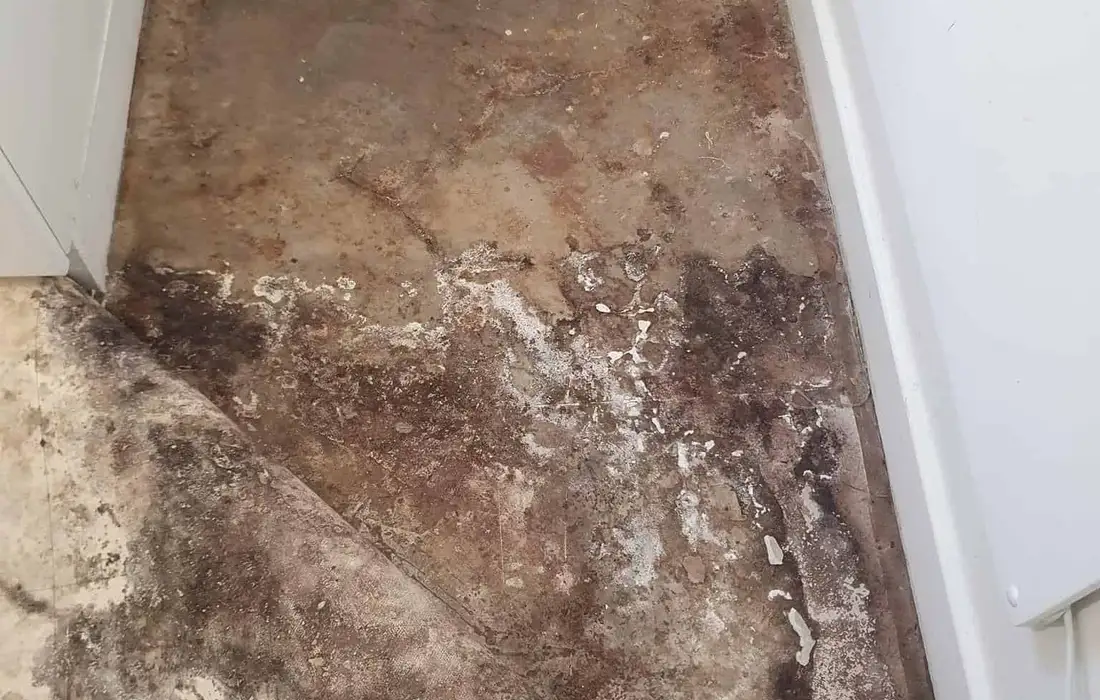
Dried-out mold isn’t harmless either. EPA says: “Dead mold may still cause allergic reactions in some people, so it is not enough to simply kill the mold, it must also be removed.” EPA’s remediation guide adds that “dead mold is still allergenic, and some dead molds are potentially toxic.”
So if you find dry, old mold, the fix is to clean or remove it and to find out what made that spot damp in the first place.
Where Moisture Hides in a “Dry” House
Use this checklist when you see or smell mold in a home that seems dry. Most of these come from EPA’s list of places hidden moisture collects.
| Where to look | Why it stays damp | What to check |
|---|---|---|
| Inside walls around pipes | Slow leaks, or cold pipes sweating | Stains, bubbling paint, soft drywall near plumbing |
| Behind furniture on outside walls | Condensation on a cold, unventilated wall | Pull furniture out a few inches and look |
| Air conditioner drip pan and drain line | Condensate pools if the line clogs | Pan should be clean; line should be flowing |
| Inside ductwork | Condensation in cooling season | Musty smell when the system runs |
| Above ceilings and in the attic | Roof leaks, or warm air condensing under the roof | Ceiling stains, damp insulation |
| Under sinks and behind appliances | Dripping supply lines and drains | Warped cabinet floors, swollen baseboards |
| Window frames and sills | Condensation on cold glass running down | Black spotting in corners of frames |
| Basements and crawl spaces | Ground moisture and cool surfaces | Musty smell, white mineral deposits on concrete |
EPA’s prevention advice for several of these is simple: “Keep air conditioning drip pans clean and the drain lines unobstructed and flowing properly,” and “Cover cold surfaces, such as cold water pipes, with insulation.”
If you can smell mustiness but can’t find the source, see why your house smells musty. A moisture meter can confirm a damp wall before it shows stains; our guide to normal moisture meter readings explains the numbers.
Mold in Dry Climates
Homes in Arizona, Nevada, Utah, inland California and west Texas get mold too. As PABCO Gypsum, a drywall maker based in the West, puts it: “Mold spores are everywhere, even in desert climate regions,” and “it does not take a great deal of water for mold to grow.”
In dry climates the moisture often comes from inside the house:
- Leaks. Plumbing and roof leaks wet materials directly, whatever the outdoor humidity.
- Evaporative (swamp) coolers. They cool by adding water to the air. A study of Utah homes found “indoor relative humidity was significantly higher in homes with evaporative coolers” than in homes with central air, and those homes spent more time above 55% and 65% humidity.
- Monsoon storms and flash floods. A single storm can wet a home faster than dry air can dry it.
The health evidence on swamp coolers is mixed. One study in the Nevada desert found 42% of people with evaporative coolers tested positive for at least one mold allergy, against 19% of those without. That’s one study, and other research has been less consistent. If you use a swamp cooler, keep its pads and reservoir clean, and check indoor humidity with a hygrometer during the cooling season.
Keep Humidity in the Safe Range
The simplest protection is to keep indoor humidity low enough that surfaces stay dry:
- EPA: keep indoor humidity “below 60 percent (ideally between 30 and 50 percent).”
- CDC: keep humidity levels no higher than 50% all day long.
A digital hygrometer costs little and shows you where you stand. If a room regularly reads above 60%, a dehumidifier will help; see how much water a dehumidifier removes for sizing. In winter, if windows run with condensation, humidity is too high for how cold your surfaces are.
After any leak or spill, act fast. EPA says: “If wet or damp materials or areas are dried 24-48 hours after a leak or spill happens, in most cases mold will not grow.”
When to Get Help
EPA says that in most cases you can handle mold yourself if the area is smaller than about 10 square feet (roughly 3 feet by 3 feet). Consider professional help when:
- Mold covers more than about 10 square feet
- There’s been significant water damage, or the source of moisture isn’t obvious
- Mold keeps coming back after cleaning
- Mold may be inside walls, ductwork or the HVAC system
- Anyone in the home has asthma, a mold allergy or a weakened immune system
CDC notes that people with asthma or mold allergies may have severe reactions, and people with weakened immune systems or chronic lung disease can get lung infections from mold. If you have health concerns, EPA advises talking to a health professional before starting cleanup. CDC doesn’t recommend testing to identify the type of mold: whatever type it is, it should be removed.
Found Mold in a Dry Spot?
Mold in a home that feels dry almost always means there’s moisture you haven’t found yet. We’ll connect you with local mold remediation and water damage professionals who can find the source, remove the growth and help keep it from coming back. Call us any time, or request a free estimate.
Frequently asked questions
Can mold grow in winter when the air is dry?
Yes. Heated indoor air may be dry, but cold exterior walls, window frames and closet corners can be much cooler than the room. The air right against those surfaces can reach 70% humidity or more, which is enough for mold, especially behind furniture where warm air doesn't reach.
Does mold die when it dries out?
Drying stops mold from growing, but it doesn't make the problem go away. EPA notes that dead mold can still cause allergic reactions, so it has to be cleaned up or removed, not just dried. If moisture comes back, growth can start again.
What humidity level stops mold growth?
EPA recommends keeping indoor humidity below 60%, ideally between 30% and 50%. CDC advises no higher than 50%. Keeping the room in that range also keeps most surfaces dry, as long as there are no leaks or very cold spots.
Can mold grow in Arizona, Nevada or other dry climates?
Yes. Desert homes still get plumbing leaks, roof leaks, air conditioner condensation and flooding from storms. Evaporative (swamp) coolers also add moisture: one Utah study found indoor humidity was significantly higher in homes that used them.
Can mold grow without water?
No. EPA states that no type of mold will grow without water or moisture. But it doesn't need standing water. Moisture absorbed into a surface from humid air or condensation is enough for some molds.
Is dry, old mold still a health risk?
It can be. EPA says dead mold may still cause allergic reactions in some people. CDC notes that people with asthma, mold allergies or weakened immune systems are most at risk. If you have health concerns, talk to a doctor before cleaning up mold yourself.
Sources
- EPA: A Brief Guide to Mold, Moisture and Your Home
- EPA: Ten Things You Should Know about Mold
- EPA: Mold Remediation in Schools and Commercial Buildings, Chapter 3
- CDC: About Mold and Your Health
- Building Science Corporation: RR-0203, Relative Humidity
- Building Science Corporation: BSD-012, Moisture Control for New Residential Buildings
- Kansas State University Research and Extension: Water Activity of Foods (MF3674)
- FDA: Water Activity (aw) in Foods
- Stevenson et al. (2017), Aspergillus penicillioides growth at low water activity, Environmental Microbiology
- ASHRAE Standard 160-2009, Addendum e (mold design criteria)
- USDA Forest Service: Wood Handbook (2021), Chapter 14
- PLOS ONE (2016): Indoor humidity in homes with evaporative coolers
- Prasad et al. (2009): Evaporative coolers and mold allergy in a desert climate
- PABCO Gypsum: Mold Growth in the Desert