How Much Water Does a Dehumidifier Remove?
Quick Answer
A dehumidifier’s pint rating is how much water it removes in 24 hours in a lab, at 65°F and 60% relative humidity. Most home units are rated 20 to 50 pints a day, which is 2.5 to just over 6 gallons. In a real home it usually removes less, because output drops as the air gets cooler and drier.
What the Pint Rating Actually Measures
The number on the box is a test result, not a promise. ENERGY STAR defines capacity as “the amount of water removed per day (24 hours) at test conditions,” reported in pints per day.
Those test conditions are set by the Department of Energy in its federal test procedure:
| Type | Test temperature | Test humidity |
|---|---|---|
| Portable dehumidifier | 65°F | 60% relative humidity |
| Whole-home (ducted) dehumidifier | 73°F | 60% relative humidity |
The air is held at those conditions for the whole test. Your basement doesn’t stay at exactly 65°F and 60% for 24 hours, and the dehumidifier switches itself off when it reaches the humidity you set. So the rating is best used for comparing one model with another, not for predicting how much water you’ll empty from the bucket.
Why Your Old 70-Pint Dehumidifier Is Now Called a 50
If you’ve shopped for a dehumidifier recently and found that the sizes look smaller than you remember, that’s the test, not the machines.
Until 2019, portable units were tested at 80°F and 60% relative humidity. Warm air at that humidity holds more water, so the same machine pulled more out and earned a bigger number. DOE moved the portable test to 65°F, closer to a real basement, with new standards that took effect in June 2019. ENERGY STAR warns that from early 2020 “you may see dehumidifiers that look comparable to previous models but have lower capacity ratings.”
Building scientist Allison Bailes put it simply: under the new test, “that 30 pint per day dehumidifier is really a 20 pint per day dehumidifier.”
ENERGY STAR publishes an approximate conversion for portable units:
| Old rating (through 2019) | New rating (2020 on) |
|---|---|
| 30 pints/day | 20 pints/day |
| 40 pints/day | 25 pints/day |
| 50 pints/day | 30 pints/day |
| 60 pints/day | 35 pints/day |
| 70 pints/day | 40 to 45 pints/day |
| 90 pints/day | 55 pints/day |
ENERGY STAR notes that “actual changes for specific models will vary.” Manufacturers often market their former 70-pint models as new 50-pint units, so you’ll see both figures. A fair rule of thumb: an old 70 is roughly a new 40 to 50, depending on the model.
What this means when you buy: check which standard a figure uses before comparing. Many listings show both, for example “50 pint (70 pint 2012 DOE standard).” A used or older unit advertised as 70 pints is not bigger than a new 50.
Pints, Gallons and Liters
There are 8 pints in a US gallon, and a pint is about 0.47 liters (NIST). Here are the common ratings converted:
| Rating | Gallons per day | Liters per day |
|---|---|---|
| 20 pints | 2.5 | about 9.5 |
| 30 pints | 3.75 | about 14 |
| 35 pints | about 4.4 | about 16.5 |
| 50 pints | 6.25 | about 23.5 |
That’s the maximum, under test conditions. A 50-pint unit removing six gallons a day would mean a very wet space.
How Much It Removes in a Real Home
Expect less than the rating most of the time. These are the things that pull the number down:
| Condition | What happens to output |
|---|---|
| Room is cooler than 65°F | Cool air holds less water, so less is removed. ENERGY STAR notes frost can form on the coils below about 65°F; frosted coils need to thaw before they remove water again. |
| Humidity is already near 50% | Very little is removed. A Minnesota Power fact sheet notes dehumidifiers are “only effective at reducing humidity when the humidity is above 50%.” |
| Unit has reached its set point | It cycles off. A unit set to 50% in a room already at 50% collects almost nothing. |
| Doors or windows open | Humid air keeps arriving, so the unit runs longer but the room stays damper. See should you close the door when using a dehumidifier. |
| Dirty filter or blocked airflow | Less air passes over the coils, so less water condenses. |
| Very damp space in summer | Output gets closest to the rating, and the bucket fills fastest. |
Check your manual for the lowest temperature your model is designed to run at. Some manuals give a floor; GE’s, for example, says not to place its units where the temperature falls below 41°F.
Measure what yours actually removes
You don’t need to guess. Over one day:
- Empty the bucket and note the time and the humidity reading (an inexpensive digital hygrometer is enough).
- Leave doors and windows to the space closed and run the unit normally.
- After 24 hours, pour the water into a measuring jug. Two cups is one pint.
- Note the humidity again.
If the unit removed a lot of water and the humidity barely moved, water is getting in faster than it can be taken out. That points to a leak, seepage or open air path worth finding. If it removed little and the humidity is in the 40s, your space is simply dry enough.
What Size Dehumidifier Do You Need?
ENERGY STAR’s current sizing guide, in pints per day:
| How damp the space is | Up to 2,000 sq ft | Over 2,000 sq ft |
|---|---|---|
| Slightly to moderately damp (50% to 75% RH) | 20 to 30 pints | 30+ pints |
| Very damp (75% to 90% RH) | 25 to 40 pints | 40+ pints |
| Wet (90% to 100% RH) | 30 to 50 pints | 50+ pints |
ENERGY STAR’s advice is that “it’s better to oversize than undersize.” A larger unit reaches the set point sooner and then cycles off, while an undersized one runs constantly and may never get there. Older sizing charts you find online often use the pre-2019 pint numbers, so treat any chart without a date with caution.
Bucket, Drain Hose or Pump?
How the water leaves matters as much as how much is collected.
- Bucket: fine for a bedroom or a space that’s only mildly damp. When the bucket is full the unit stops, so in a wet basement you’ll be emptying it every day or more.
- Drain hose: many portable units have a fitting for a garden-style hose. If there’s a floor drain lower than the unit, gravity does the work and the unit runs without stopping.
- Condensate pump: built in on some models, or added separately. It pushes water up and out to a sink or drain, which is the answer when there’s no floor drain. ENERGY STAR says whole-home units should be routed to a floor drain or condensate pump.
ENERGY STAR also advises keeping drain hoses away from electrical cords and connections.
Running Cost and Efficiency
ENERGY STAR rates efficiency as the integrated energy factor (IEF), in liters of water removed per kilowatt-hour of electricity. Higher is better. Certified models use about 20% less energy than standard ones. Under the current specification (Version 6.0, effective October 1, 2025), a portable unit rated over 50 pints a day must reach at least 3.30 liters per kWh to qualify.
If you’ll run a dehumidifier most of the summer, the ENERGY STAR label is worth paying a little more for.
When a Dehumidifier Isn’t Enough
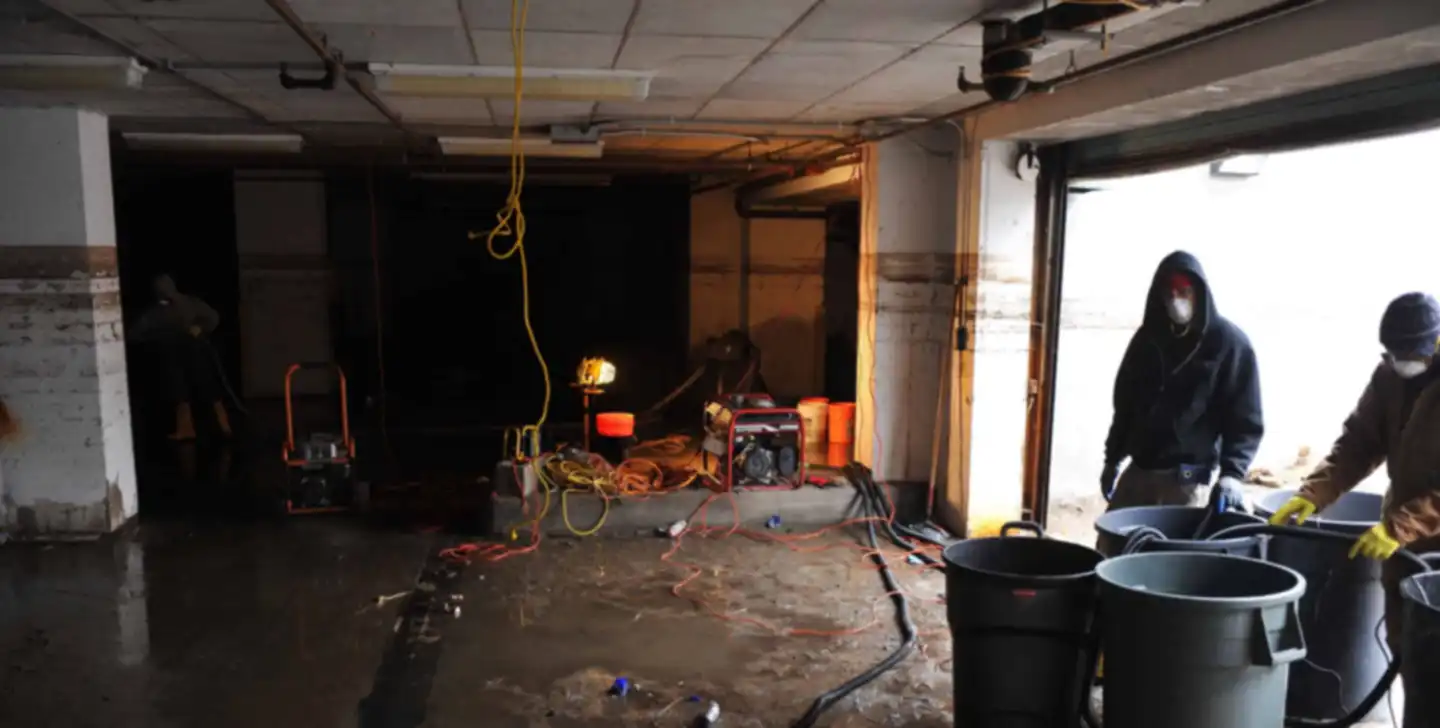
A home dehumidifier is built to keep air at a healthy humidity. It is not built to dry a building after a flood or a burst pipe.
After water damage, the water isn’t just in the air. It’s soaked into drywall, insulation, carpet pad, subfloors and framing, and it keeps evaporating for days. EPA advises drying water-damaged areas and items within 24 to 48 hours to prevent mold growth. One portable unit can’t remove water at that rate from a wet room.
Professional water damage restoration crews work to the IICRC S500 standard. They extract standing water, use commercial dehumidifiers and air movers sized to the wet area, and track drying with moisture meter readings until materials are back to normal. Our guide to normal moisture meter readings explains what those numbers mean.
Signs you need more than a dehumidifier:
- Standing water, or carpet that squelches underfoot
- Drywall that is soft, stained or swelling at the base
- A musty smell that keeps coming back (see why your house smells musty)
- Humidity that won’t drop below 60% even with the unit running nonstop
- Visible mold, which may need mold remediation
Need Help Drying Out Your Home?
If a leak, flood or burst pipe has left your home wet, we’ll connect you with local water damage and mold professionals who can extract the water, dry the structure and check it with moisture readings. Call us any time, day or night, or request a free estimate.
Frequently asked questions
How long does it take a dehumidifier to fill its bucket?
Divide the bucket's capacity by how fast the unit is removing water. A unit pulling 30 pints a day fills a 15-pint bucket in about 12 hours. In a damp basement in summer it may fill twice a day; once the space is under control it can take several days. Your manual lists the bucket size.
Is a 50-pint dehumidifier big enough for a basement?
For most basements, yes. ENERGY STAR's sizing guide suggests 30 to 50 pints a day for a very damp to wet space under 2,000 square feet, and more above that. If the space smells musty, has wet spots or reads above 75% humidity, size up rather than down.
Why is my dehumidifier collecting hardly any water?
Usually because there is not much left to collect. Below about 50% relative humidity a dehumidifier removes very little. Other causes are a cold room (output drops as the air cools, and coils can frost below about 65°F), a clogged filter, or doors and windows letting humid air in faster than the unit can remove it.
Can a dehumidifier dry out a flooded basement?
Not on its own. Standing water has to be pumped or extracted first, and soaked carpet, pad and drywall usually need to come out. EPA advises drying water-damaged areas within 24 to 48 hours to prevent mold, which takes professional drying equipment after a real flood.
What humidity should I set my dehumidifier to?
EPA recommends keeping indoor humidity below 60%, ideally between 30% and 50%. Setting the unit to around 45% to 50% keeps most homes in that range without running constantly. In cold climates, keep winter humidity nearer 30% to 40% to avoid window condensation.
Sources
- ENERGY STAR: Dehumidifier testing and capacity
- eCFR: 10 CFR 430, Appendix X1 (dehumidifier test procedure)
- ENERGY STAR: Dehumidifiers (sizing, placement and use)
- ENERGY STAR: Dehumidifier key efficiency criteria (Version 6.0)
- Green Building Advisor: The confusing world of dehumidifier capacity
- EPA: A Brief Guide to Mold, Moisture and Your Home
- NIST: Approximate conversions from US customary measures to metric
- Minnesota Power: Dehumidifier fact sheet
- IICRC: S500 Standard for Professional Water Damage Restoration