
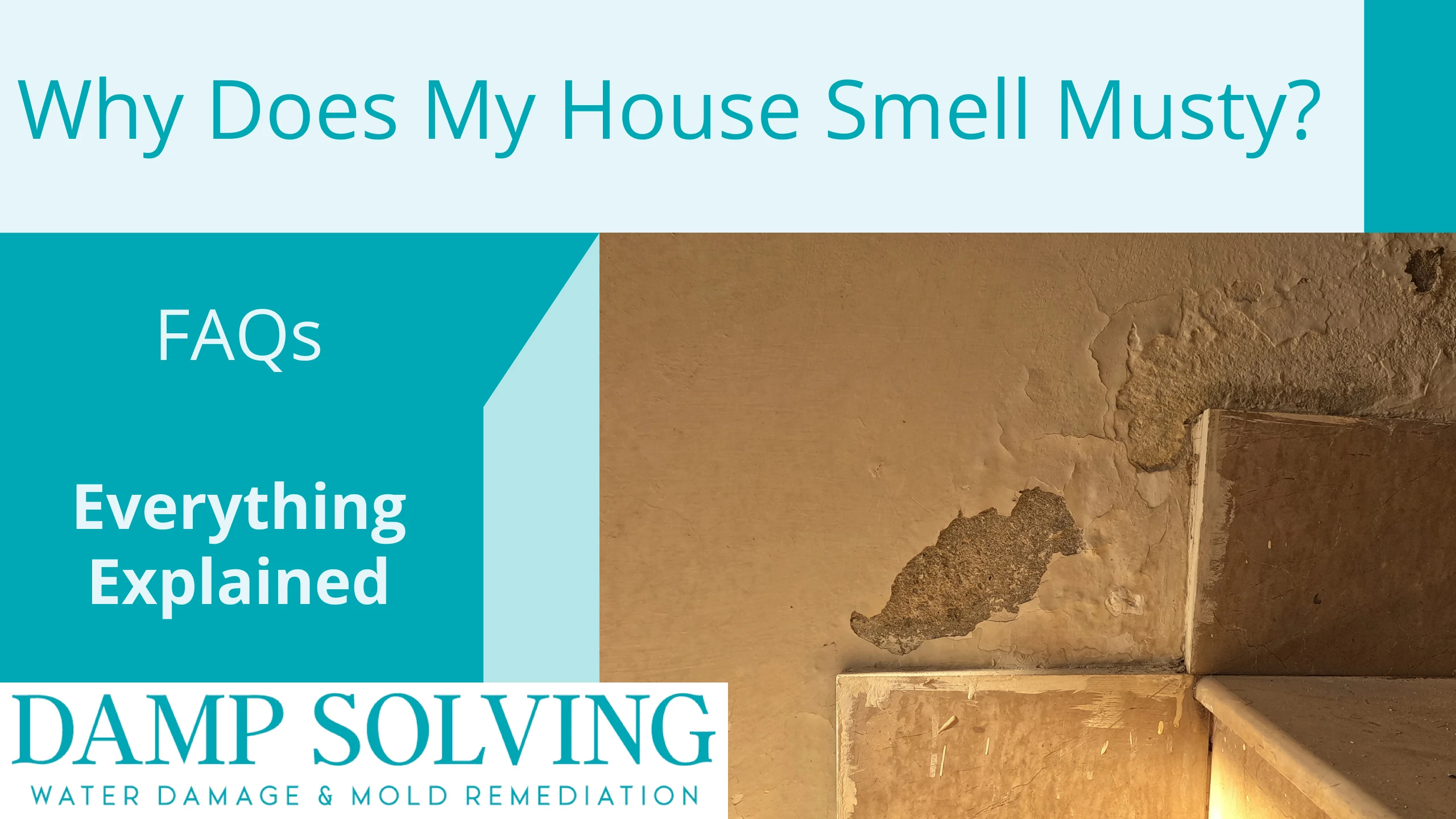
Why Does My House Smell Musty?
Quick Answer
A musty smell in your house usually means moisture is trapped somewhere in the building, allowing mold or mildew to grow. Common sources include damp drywall, wet insulation, hidden leaks, or high indoor humidity. Even when mold isn’t visible, the smell often points to moisture problems inside walls, ceilings, floors, or your HVAC system.
What Causes a Musty Smell in a House?
That stale, earthy odor has a chemical name: microbial volatile organic compounds, or mVOCs. Mold and mildew release mVOCs as they feed on organic material — wood, drywall paper, carpet fibers, insulation. The smell is often the first sign you have a moisture problem, arriving well before visible growth appears.
Common sources include:
- Hidden mold behind drywall or under flooring — often caused by a slow leak or past flood event
- Damp insulation in walls, attics, or crawlspaces — insulation holds moisture and stays wet far longer than hard surfaces
- Wet carpets or carpet pads — even a small water intrusion can leave backing saturated for weeks
- Crawlspace moisture — ground vapor migrates upward into living areas, especially in humid US climates
- Roof leaks — water tracks down rafters and can saturate attic insulation silently for months
- HVAC ducts — condensation inside ductwork creates ideal mold conditions that spread odor throughout every room
- High indoor relative humidity sustained above 60% — feeds surface mold on walls, grout, and window frames
Why Your House Smells Musty but You Can’t See Mold
This is the most common situation homeowners describe, and it’s frustrating because there’s nothing obvious to clean. Mold doesn’t need to be visible to smell.
The smell-without-sight scenario happens because:
- Mold grows on the back side of drywall, where it’s dark, warm, and undisturbed
- Growth inside wall cavities is fed by a pinhole leak or condensation on cold pipes — you’d never see it through finished walls
- HVAC ductwork is dark and rarely inspected; even a small patch of mold inside a duct will distribute odor to every room the system serves
- Moisture in attic insulation stays hidden under fiberglass or blown-in material; mold colonies can be extensive before any ceiling stain appears
- Crawlspace mold and mildew on floor joists migrate upward through gaps around pipes, wiring, and subfloor seams
If you’ve cleaned every surface and the smell returns, the source is almost certainly concealed. That’s when professional moisture assessment makes sense.
Signs That Moisture Is Behind the Smell
These physical indicators confirm a moisture problem rather than a simple dust or ventilation issue:
- Musty smell is stronger after rain or during humid weather — outdoor moisture is entering or driving up indoor levels
- Paint or wallpaper bubbling or peeling away from the wall surface
- Damp patches, discoloration, or soft spots on walls, ceilings, or floors
- Condensation on windows, especially in cold weather — indicates high indoor humidity
- Warped or buckling wood floors or baseboards
- Rust stains around fasteners in drywall or on metal fixtures
- Allergy-like symptoms (sneezing, runny nose, eye irritation) that improve when you leave the house
The EPA and CDC both note that any visible mold growth — regardless of color — warrants assessment and remediation. The same applies when the smell is present without visible growth.
Why the Smell Is Stronger After Rain
A musty smell that intensifies after rain is a reliable indicator of one of two things: moisture is entering the building envelope (cracks in the foundation, gaps around windows, or roof vulnerabilities), or rising outdoor humidity is pushing your indoor relative humidity high enough to activate dormant mold or mildew that’s already present.
If your home smells fine in dry weather but musty every time it rains, start by checking:
- Foundation walls and basement floor for water entry or efflorescence (white mineral deposits from water wicking through concrete)
- Window and door frames for gaps or failed caulking
- Gutters and downspouts — blockages cause water to pool near the foundation
- Crawlspace vents — ensure they’re not blocked and that a ground vapor barrier is in place
Musty Smell in a Specific Room? Here’s What That Tells You
Bedroom
A musty smell in a bedroom often comes from the closet (poor airflow traps moisture), under the bed (carpet pad), or an exterior wall with hidden condensation. Check that the bedroom has adequate ventilation, especially if it has carpet.
Basement
Basements are high-risk because they sit below grade, where soil moisture is constant. Bare concrete walls wick moisture; even finished basements with drywall over concrete can harbor mold in the wall cavity. A dehumidifier keeping relative humidity at or below 50% is standard guidance for US basements.
Walls
A musty smell specifically from walls — or that seems to seep from a particular wall — strongly suggests mold inside the wall cavity. Possible causes include a leaking pipe in the wall, roof or window flashing failure above, or condensation on a cold exterior wall surface.
How to Check for Hidden Moisture
Before calling a professional, you can do a basic survey using a moisture meter. This tool tells you whether drywall, wood, or flooring is holding more moisture than it should — no cutting required.
- A moisture meter reading of 0–12% in wood is generally dry
- Readings of 13–17% indicate elevated moisture and should be investigated
- Readings above 17% in wood or above 1–2% in drywall indicate active or recent water intrusion
For detailed guidance on interpreting readings by material type, see our guide on what a normal moisture meter reading looks like at dampsolving.com/normal-reading-moisture-meter.
A thermal imaging camera can show temperature differences behind walls and ceilings that indicate wet areas — this is a standard tool in professional moisture assessments per IICRC S500 protocols.
When a Musty Smell Means Serious Water Damage
Not all musty smells are equal. The following situations go beyond a humidity issue and typically require professional structural drying and mold remediation:
- The smell appeared suddenly after a flood, burst pipe, or appliance leak
- You’ve had a visible leak or water intrusion event that wasn’t dried within 24–48 hours — mold begins colonizing within that window under warm conditions
- The smell has persisted for weeks despite cleaning, ventilation, and dehumidification
- You see any visible mold growth larger than 10 square feet (EPA threshold for DIY vs. professional remediation)
- Anyone in the household has respiratory conditions, is immunocompromised, or is experiencing worsening symptoms at home
Water damage that isn’t fully dried leaves behind conditions that sustain mold growth indefinitely. Professional structural drying follows IICRC S500 standards, using moisture mapping, calibrated drying equipment, and verification readings to confirm structural materials have returned to acceptable moisture levels before reconstruction.
For a full overview of what water damage restoration involves, see dampsolving.com/water-damage-restoration.
Is a Musty Smell Keeping You Up at Night?
If a musty odor keeps returning after cleaning — or you’ve had any water intrusion event — moisture may be trapped inside your walls, floors, or ceiling materials. Damp Solving provides professional moisture assessments, structural drying, and mold remediation. Call us today or use the contact form to schedule an inspection.
Frequently Asked Questions
Is a musty smell always mold?
Not always. Mildew (early-stage mold on surfaces), bacterial growth, and accumulated dust in an unventilated space can also produce musty odors. However, any persistent musty smell should be treated as a potential mold or moisture indicator until proven otherwise, because the consequences of ignoring actual mold growth are significant.
Can I get rid of the musty smell myself?
If the source is surface mildew — visible growth on bathroom grout, window sills, or other hard, non-porous surfaces — you can clean it with an EPA-registered disinfectant and address the humidity issue. If the smell is coming from inside walls, the HVAC system, or a crawlspace, professional assessment is the appropriate path. Masking the odor with air fresheners doesn’t resolve the underlying problem.
How much does mold remediation cost?
Cost varies significantly depending on the area affected, the materials involved, and how far growth has spread. Small surface cleanups cost far less than full wall-cavity remediation requiring drywall removal and structural drying. Getting a professional assessment early — before the problem spreads — typically reduces total cost. Contact Damp Solving for a site-specific estimate.
Does a dehumidifier fix a musty smell?
A dehumidifier can reduce the conditions that sustain mold growth and may reduce odor intensity if the source is surface mildew responding to high humidity. It will not eliminate mold that is already established, and it won’t address a hidden water intrusion source. Think of a dehumidifier as a maintenance tool — not a remediation tool.
What indoor humidity level prevents musty smells?
The EPA recommends maintaining indoor relative humidity between 30–50%. At or below 50%, mold growth and mildew are significantly inhibited on most surfaces. During US summer months in humid climates, active dehumidification is often required to stay within this range.
External References
- EPA — A Brief Guide to Mold, Moisture and Your Home: epa.gov/mold/brief-guide-mold-moisture-and-your-home
- CDC — Mold: cdc.gov/niosh/topics/indoorenv/mold.html
- IICRC S500 Standard for Professional Water Damage Restoration: iicrc.org (reference standard for moisture mapping and drying verification)
- EPA — Introduction to Indoor Air Quality: epa.gov/indoor-air-quality-iaq
- DOE — Moisture Control in Homes: energy.gov/energysaver/moisture-control
Common Musty Smell Locations at a Glance
Use this as a quick reference to identify the most likely source based on where the smell is strongest:
| Location | Likely Cause | First Step |
|---|---|---|
| Basement | Ground moisture or poor ventilation | Run dehumidifier; check walls for water entry |
| Bedroom | Damp carpet pad or closet humidity | Inspect carpet backing; improve air circulation |
| Walls | Hidden pipe leak or condensation | Use moisture meter on drywall; check plumbing |
| Attic | Roof leak or damp insulation | Inspect roof deck and insulation after rain |
| HVAC system | Mold inside ductwork or drain pan | Change filter; have ducts professionally inspected |
| Crawlspace | Ground vapor or standing water | Check vapor barrier; inspect joists for mold |
| Bathroom | Poor exhaust ventilation or grout mold | Run exhaust fan; inspect caulk and grout lines |
25 Years of Experience
We Tackle Water Damage & Mold Remediation In Your Area.
Very helpful guide which helped me get to the route of my musty smell in bedroom.
A.Jones – Austin,TX